How we work

Working with you. Accountable for the work.

A defined mandate, senior technical ownership, and a practical path from the first decision to implementation.

The engagement follows the situation

Start with what needs to change.

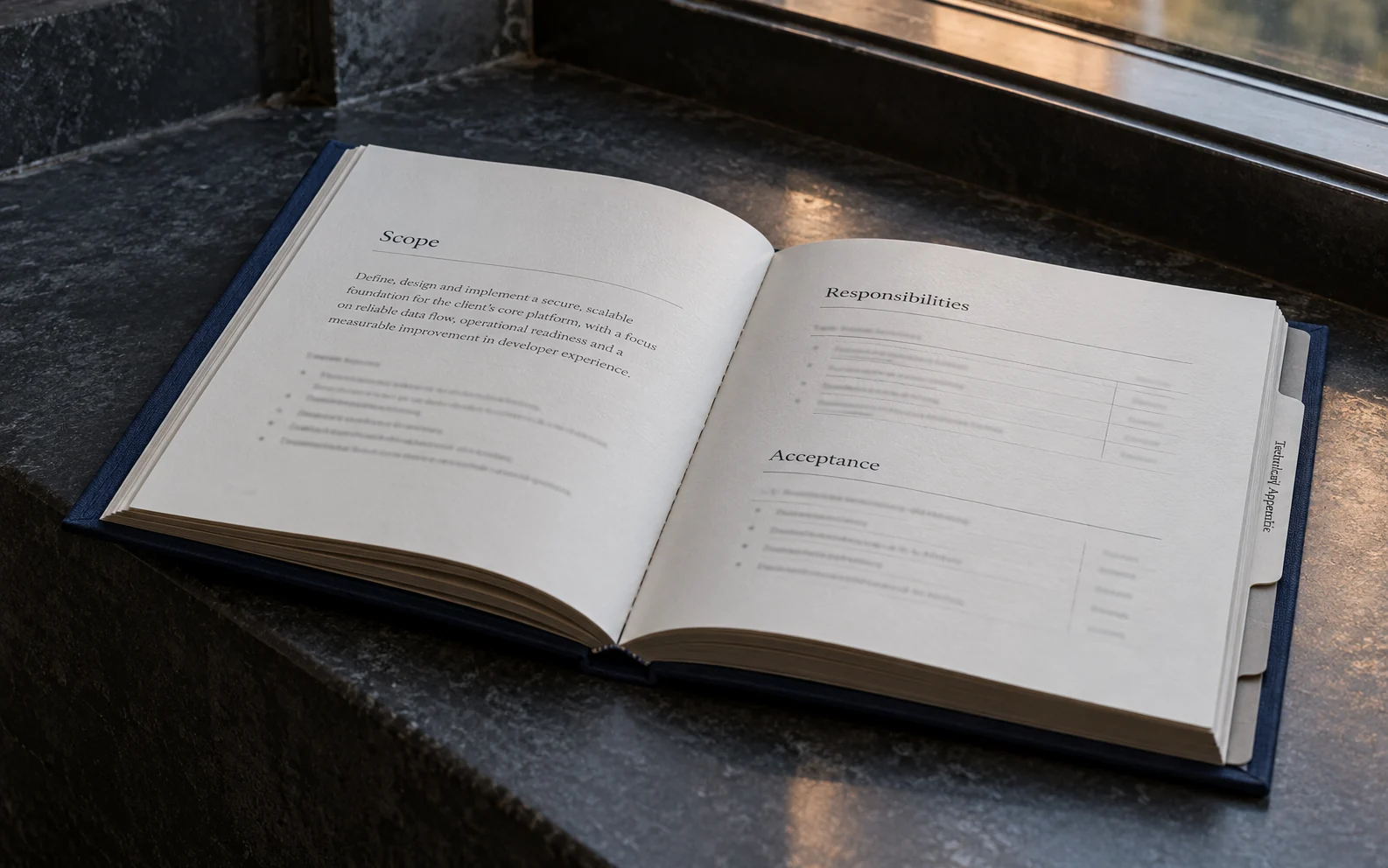
We begin by understanding the objective, the current situation, and the constraints. Scope, responsibilities, deliverables, and commercial terms are agreed before an engagement starts.

These are common ways to work with us. An introductory conversation can help clarify which approach fits.

01 / Engagement option

Assess and decide

Assessment details

A consequential decision is approaching, but the current state, options, or delivery risk are not yet clear.

Initial output
Findings, critical dependencies, practical options, and a recommended sequence for moving forward.
Defining the scope
Agree the decision to support, the systems and people involved, and the evidence needed to make the recommendation.
02 / Engagement option

Deliver or recover

Discuss delivery or recovery

An integration, modernization, or critical initiative needs technical ownership and coordinated execution.

Initial output
A recovery engagement starts with diagnosis and a sequenced plan. A defined delivery workstream starts with an implementation plan and acceptance gates, then proceeds through the agreed build, testing, and handover.
Defining the scope
Establish the intended operating outcome, immediate blockers, workstreams, responsibilities, and measures of completion.
03 / Engagement option

Ongoing technical leadership

Technical leadership details

Several decisions or workstreams need sustained senior direction across your teams, systems, and vendors.

Initial output
An agreed set of priorities, decision responsibilities, and a working cadence that keeps direction connected to delivery.
Defining the scope
Define the mandate, decision authority, specialist needs, and review points as the work evolves.

Our delivery approach

Move forward with the evidence to support it.

  1. Assess the situation

    Review the business requirement, current environment, dependencies, and constraints. Identify the questions that need to be resolved.

  2. Define the engagement

    Agree the architecture, scope, priorities, responsibilities, commercial terms, and evidence required for completion.

  3. Implement and coordinate

    Coordinate the firm’s work with client teams and vendors. Resolve technical issues, track dependencies, and review decisions as implementation proceeds.

  4. Validate and hand over

    Test against the agreed requirements, support transition, address remaining issues, and provide operating documentation and ownership.

Deliverables and setup

Know what completion looks like.

The proposal identifies the required outputs and how they will be accepted. Depending on scope, these may include assessment findings, architecture, a tested implementation, cutover records, or operating documentation.

Connect with TMG

Where should we begin?

Tell us what you need to accomplish and where the project stands.